


A lamp's light beam determines how the light falls in a room and how far it reaches. Especially with spotlighting and track lighting, choosing a narrow or wide light beam can make a big difference. Do you want to highlight a painting or illuminate an entire room? The right light beam ensures that the lighting perfectly matches your needs.
In this blog, you will discover which light beams are available, how they affect your lighting, and which one best suits your application.
What is a light beam?
The light beam, also known as the beam angle or angle of dispersion, indicates how widely light radiates from a lamp. This is expressed in degrees.
- Narrow light beams (10–25°) produce a concentrated beam of light and are often used for accent lighting.
- Wide light beams (50° or more) spread the light over a larger area and are suitable for general lighting.
With track lighting, choosing the right light beam is especially important, as it determines the atmosphere and functionality of the space.
Types of light beams and their applications
Below, you can see the different types of light beams and their applications:
| Light beam (beam angle) | Application | Examples |
|---|---|---|
| Narrow beam (10–25°) | Spotlighting and accent lighting | Paintings, art, display cases, products in shops |
| Medium beam (30–45°) | Focused lighting for workspaces and ambient lighting | Dining room, kitchen, workspace |
| Wide beam (50° or more) | General lighting for large spaces | Living room, office, showroom, hospitality venues |
| Adjustable beam (zoom spotlight) | Flexible lighting for commercial applications | Shops, galleries, showrooms, offices |
The narrower the beam, the more powerful and focused the light. The wider the beam, the larger the illuminated area, but with less intensity.
Beam angles and track lighting: what do you need to know?
Track lighting is often used in homes, stores, offices, and hospitality venues. The right beam angle ensures that the lighting is both functional and atmospheric.
- Want to highlight a product, painting, or specific area? Choose a narrow beam angle of 10–25°. This creates a focused beam of light and adds accents.
- Want to illuminate a larger area, such as a counter, workspace, or dining table? A medium-wide beam angle of 30–45° offers a good balance between focused and general lighting.
- Want to illuminate an entire space evenly? Choose a wide beam angle of 50° or more. This is ideal for general lighting in stores, offices, and showrooms.
- Looking for maximum flexibility? Choose a zoom spotlight with an adjustable beam angle ranging from narrow to wide.
At Qub Track Lighting, we offer a range of spotlights with different beam angles, so you can easily make the right choice for your application.
The Zoom Spotlight for 3-circuit track lighting: maximum flexibility for commercial applications
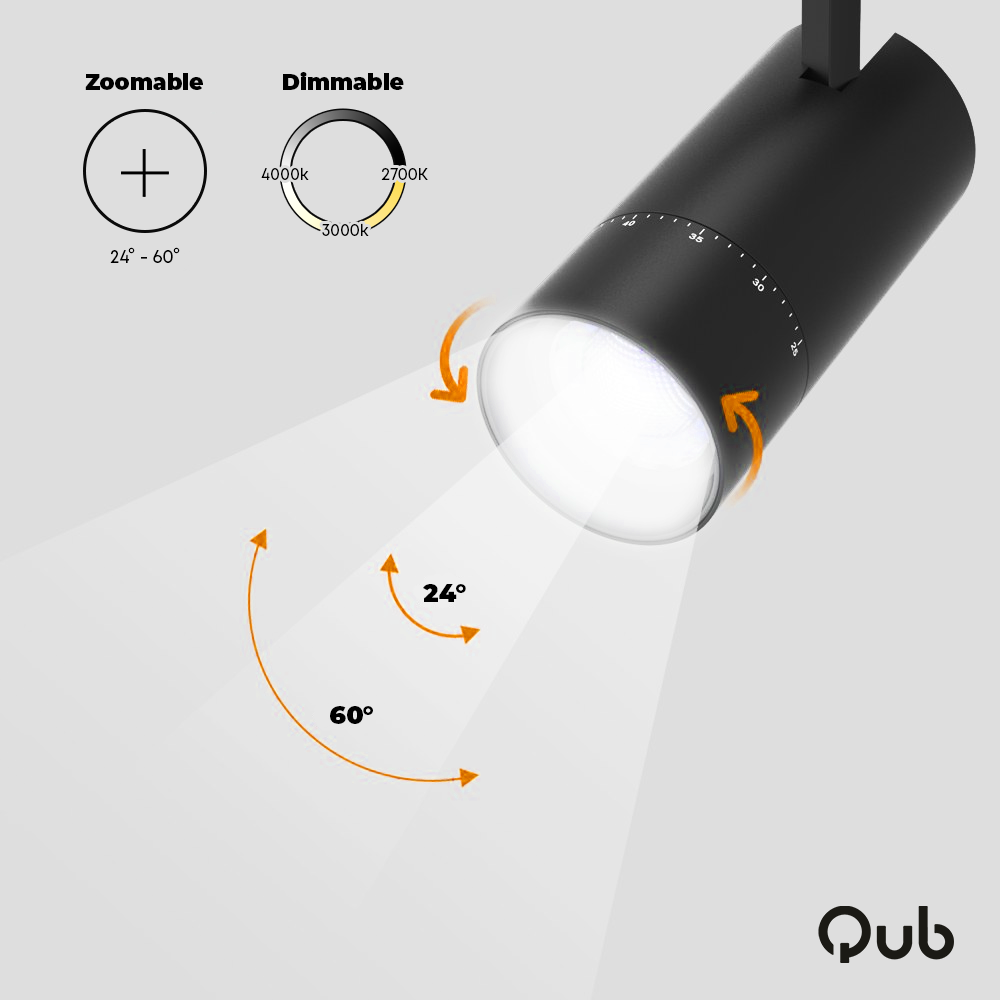
For business customers seeking maximum flexibility, the Qub Zoom Spotlight for 3-circuit track lighting is an excellent choice.
What makes this spotlight unique?
- Adjustable beam angle – Adjust the beam angle from narrow spotlighting to broad general lighting.
- Adjustable color temperature – Choose the right light color for the application, from warm white to cool white.
- Adjustable wattage – Adjust the light intensity to the space and the desired atmosphere.
Who is this spotlight suitable for?
- Stores and showrooms – Adjust the lighting for each product or collection without installing new spotlights.
- Galleries and museums – Easily change the lighting of artworks without modifying the track system.
- Offices and workspaces – Create task lighting during the day and a warmer atmosphere in the evening.
This spotlight offers an all-in-one solution for commercial customers who do not want to be limited to a single lighting setting.
How do you choose the right beam angle?
When choosing the right beam angle, the following questions are important:
-
What do you want to illuminate?
Do you want to illuminate a specific object, a table, or an entire room? -
How high is the ceiling?
With high ceilings, a beam that is too wide may result in insufficient light at the workspace. In that case, a narrower beam is more suitable. -
What kind of atmosphere do you want to create?
A narrow beam creates contrast and dynamism, while a wide beam provides soft, even lighting.
Combining beam angles
A combination of different beam angles is often most effective. In a store, for example, a wide beam can provide general lighting, while narrower beams highlight products.
In homes, a track lighting system may, for example, consist of:
- Wide-beam spotlights (50°+) for general lighting.
- Focused spotlights (25°–30°) for workspaces and mood lighting.
- Narrow-beam spotlights (10°–15°) for decorative accents, such as art or furniture.
- Zoom spotlights for maximum flexibility in commercial environments.
Conclusion: which light beam is best suited to your situation?
- Accent lighting or product lighting? Choose a narrow beam (10–25°).
- Task lighting or functional lighting? Choose a medium beam (30–45°).
- General lighting for an entire room? Use a wide beam (50° or more).
- High ceilings? Choose a narrower beam so the light remains powerful.
- Maximum flexibility? Choose a zoom spotlight with an adjustable beam angle, color, and wattage.
At Qub Rail Lighting, we are happy to help you choose the right lighting. Browse our range of track spotlights and discover the possibilities.


